
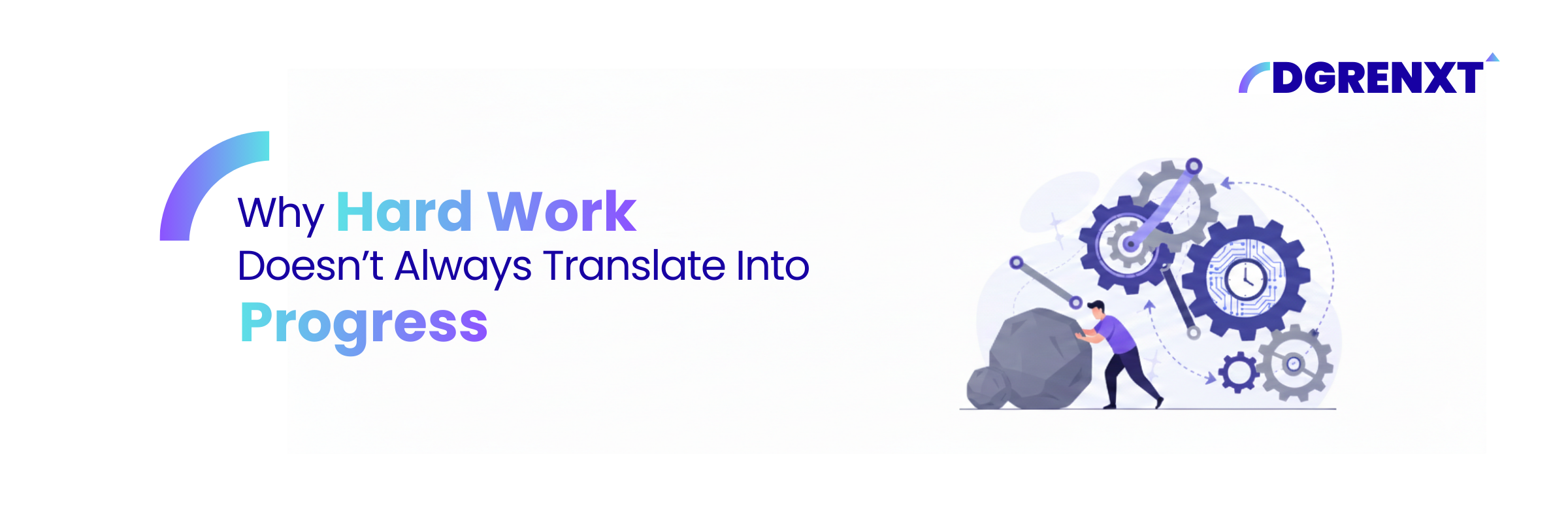
Why Hard Work Doesn’t Always Translate Into Progress
There’s a quiet frustration that many professionals carry: “I’m working harder than ever. So why am I not moving forward?” The hours are long. The effort is real. The intent is sincere. And yet… progress feels slow. Sometimes invisible. Sometimes nonexistent. This isn’t laziness. It’s not a lack of ambition. It’s not a motivation problem. It’s usually a direction problem disguised as effort.
Hard Work Multiplies Whatever Direction You’re Already In
Hard work is a multiplier. If your direction is right, effort accelerates you. If your direction is unclear, effort exhausts you. The problem is simple but uncomfortable: Most people increase effort before validating alignment. You can push 10x harder but if the trajectory is slightly off, you’ll just drift faster.
The Effort Illusion
Effort feels productive. Staying late feels productive. Saying yes to more responsibilities feels productive. Being busy feels productive. Solving urgent problems feels productive.
But activity is not the same as advancement. Progress requires movement toward something. Hard work without direction becomes motion without distance. And motion without distance feels like stagnation.
The 3 Hidden Reasons Hard Work Fails
Most stagnation isn’t about capability. It’s about structure.
- Misaligned Cores You’re working hard in areas that don’t leverage your strongest Core Powers. So your effort feels heavy instead of compounding.
- Reactive Work Pattern You’re constantly responding, rarely designing. Hard work in reactive mode builds survival, not trajectory.
- Lack of Ownership Shift You’re executing well; but not expanding scope. Growth often requires evolving from “doing well” to “defining better.”
Hard work sustains performance. It doesn’t automatically elevate position.
When Effort Becomes Emotional Currency
There’s another layer to this. Sometimes we subconsciously believe: “If I work hard enough, someone will notice.” But growth rarely rewards visibility alone. It rewards structural contribution. You don’t move forward because of how much energy you spend. You move forward because of how much clarity you create. That’s a different game.
Progress Requires Three Shifts
Hard work starts working when these shifts happen:
- From volume of work to quality of decisions
- From task execution to outcome ownership
- From busyness to strategic clarity
Progress is not about doing more. It’s about doing differently.
The Real Question You Should Be Asking
Instead of asking: “Why am I not progressing despite working so hard?” Try asking:
- Am I working on the right problems?
- Am I using my strongest Core Powers consistently?
- Am I expanding my scope or just repeating competence?
- Is my effort compounding or just sustaining?
That shift alone changes trajectory. Because once clarity improves, effort becomes leverage.
Hard Work Is Fuel. Direction Is Steering.
Fuel without steering burns out. Steering without fuel stalls. But when both align, momentum feels almost unfair. This is where most professionals need help; not with effort, but with alignment. The DgreNxt framework focuses exactly there: identifying structural strengths, growth gaps, and operating patterns so effort actually translates into movement. Because hard work should feel progressive - not repetitive.