
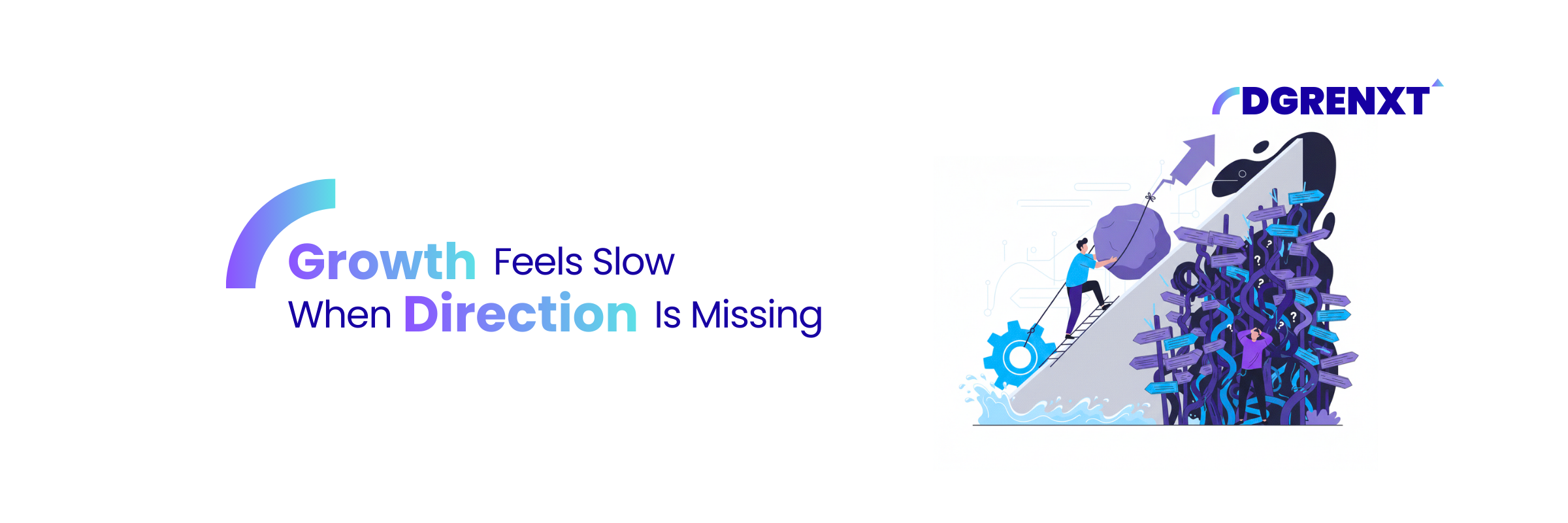
Growth Feels Slow When Direction Is Missing
There are phases in a career where effort remains constant but progress feels delayed. You are learning, contributing, improving, and yet the movement feels incremental instead of exponential. The frustration does not come from laziness or lack of ambition. It comes from sensing that your energy is not translating into visible momentum. Most people respond to slow growth by increasing effort. They work longer hours, enroll in more courses, or take on additional responsibilities. While those actions can build capability, they do not always change trajectory. Growth that lacks direction often feels like motion without measurable distance. When direction is unclear, speed becomes irrelevant.
Activity Creates Movement. Direction Creates Progress.
It is easy to confuse movement with advancement. Delivering projects, solving problems, and meeting targets all create a sense of productivity. However, productivity does not automatically equal progress. Progress requires alignment between effort and long-term positioning. Imagine walking quickly in the wrong direction. You are still moving, but you are not arriving. Many professionals operate in this pattern. They are active but not intentional. Their calendar is full, yet their long-term path remains undefined. Over time, this creates subtle anxiety because the mind senses effort without clarity.
Why Slow Growth Feels Personal
When growth slows, it often feels like a personal limitation. You may begin questioning your capability, your intelligence, or your potential. Comparison intensifies the feeling. Others appear to be accelerating while you remain steady. However, growth is rarely linear across individuals. Different operating styles produce different rhythms of advancement. Some grow through rapid visibility. Others grow through deep mastery. Without understanding your structural strengths and gaps, you may try to grow in a pattern that does not match you. Misaligned growth always feels slower than aligned growth.
The Missing Link Between Effort and Momentum
Direction is the bridge between effort and acceleration. Without it, effort remains isolated actions. With it, effort compounds. Direction becomes clearer when you understand:
- How you make decisions
- What environments energize you
- Which Core Powers drive your best performance
- Where your structural gaps slow you down
- What type of ownership expands you
These factors influence whether your work compounds or simply sustains. Clarity reduces friction. When friction reduces, momentum increases naturally.
Signs That Direction Is Missing
Slow growth often shows up through patterns rather than events. You may notice:
- Consistent work without noticeable expansion
- Repeated roles with minor variation
- Increased effort without increased influence
- Learning that does not translate into positioning
- Uncertainty about your next meaningful step
None of these indicate failure. They indicate misalignment between effort and direction. The absence of direction quietly drains motivation.
How Direction Accelerates Growth
When direction becomes defined, decisions simplify. You stop saying yes to everything and start choosing selectively. Your energy becomes concentrated instead of scattered. Learning becomes intentional rather than reactive. Growth does not suddenly become effortless. It becomes structured. Structured growth compounds because each action builds upon the previous one. Instead of random improvement, you create a clear arc of development. This is why frameworks like the DgreNxt growth framework emphasize structural clarity. When you identify your Core Powers and understand how you naturally operate, you begin aligning effort with trajectory. Aligned effort feels lighter.
Slow Growth Is Often a Signal, Not a Verdict
Periods of slow growth are not permanent labels. They are feedback. They signal that either your environment or your operating structure requires recalibration. Increasing speed without adjusting direction rarely produces sustainable results. Once clarity improves, even small actions start compounding. Momentum does not come from intensity alone. It comes from alignment.